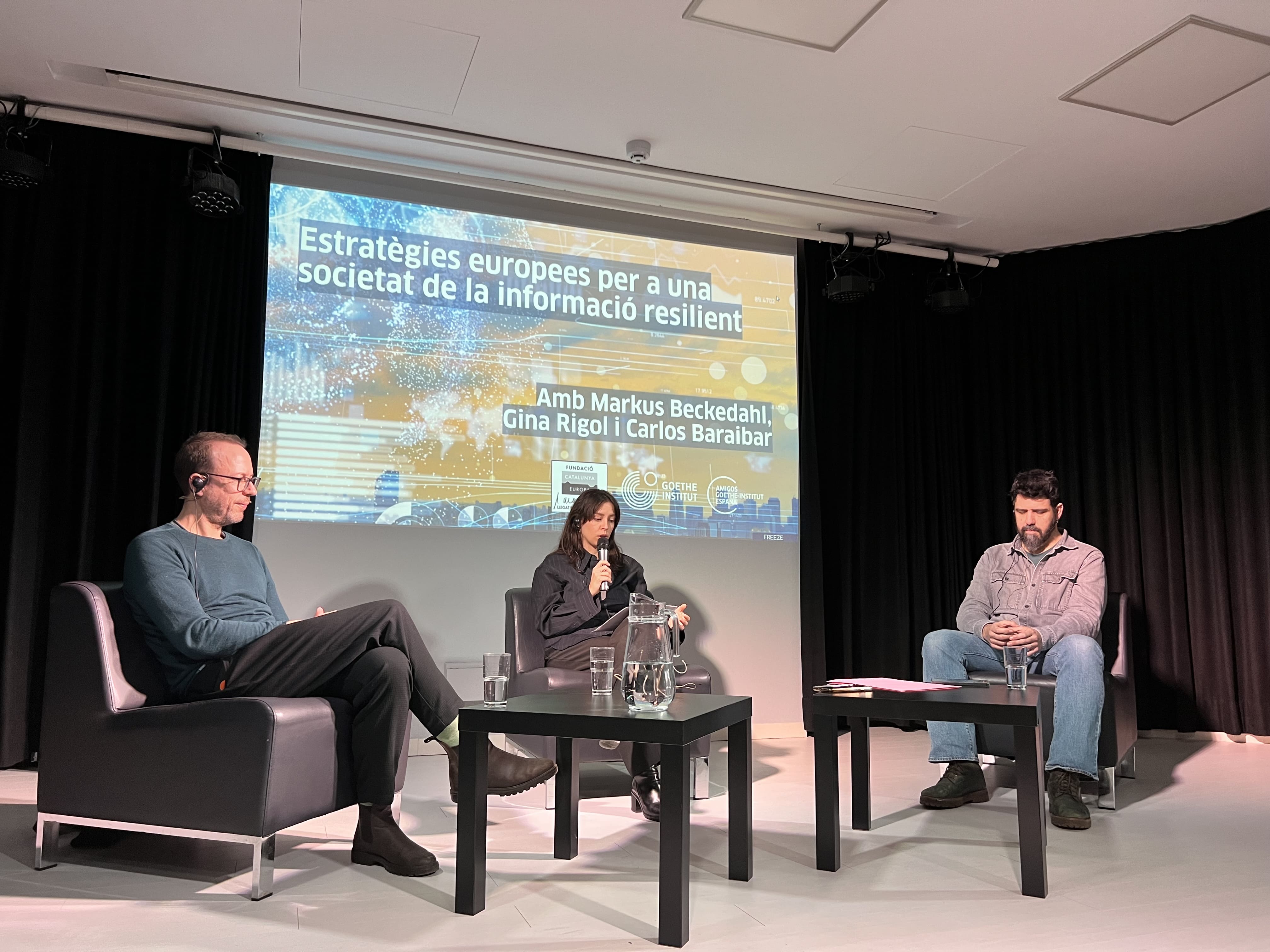
This Tuesday, November 25, the Catalunya Europa Foundation held a debate at the Goethe-Institut, bringing together Markus Beckedahl and Carlos Baraibar, moderated by Gina Rigol, to discuss how to build a more resilient society in a context of unprecedented access to information, dominated by major platforms and the proliferation of disinformation.
The Situation in Europe and Spain
Gina Rigol opened the debate with two central questions: “How do we get informed and who informs us? How do we address these strategies to build a more resilient society?”
Based on a report from the Digital News Report, she highlighted that traditional media continue to decline, while reliance on social media for information keeps increasing, with 46% of the Spanish population getting news through social media platforms.
Markus Beckedahl described the generational differences: “I have a mix of conventional and new media, but I belong to an intermediate generation. My older relatives watch television, and young people watch TikTok or Instagram.”
Carlos Baraibar added: “The CEO says that people between 16 and 49 years old acknowledge that they get most of their information from social media; this is half the population or more.” He also noted that 80% of these users were aware they would encounter false news: “We are in a technological adolescence; we’ve only been learning to consume information this way for a few days.”
Carlos explained the efforts of traditional media to adapt to new formats and gain visibility from algorithms: “Established media try to adapt to a world that depends on what is politically convenient for the platform owners. We must understand the algorithms and operate according to the same logic we infer from the platforms. We need to attract people to our platform, but to do so, we have to enter the battle and find a format that reaches the entire population.”
Gina Rigol asked how reliable information can be delivered in an ecosystem dominated by major platforms and how to create new spaces where traditional media can regain prominence. She also questioned whether traditional media still generate trust in a context where citizens seek sources they perceive as close.
Markus made it clear that distrust toward the media is justified: many journalists “have forgotten to explain how they work” and have mismanaged mistakes. Regaining trust, he said, requires more transparency and incorporating elements of constructive journalism—not just describing the apocalypse, but offering solutions and alternative perspectives. Journalism must be diverse in its content, and the people who report must be diverse. It is important that the audience feels acknowledged and part of the investigation.
Carlos Baraibar, for his part, pointed out that information “has become institutionalized, as if relevant information could not exist on social media. This has created distance from citizens. The process generated distrust and strained everything.”
Gina, who works with content creators, highlighted that new creators do generate trust and bring “fresh air,” but they also raise questions about who is behind them and how their informational responsibility is ensured.
Risks and Opportunities in the Information Age
More than half of the population is concerned about distinguishing between false and true news. Is our civil society prepared to make this distinction?
Carlos Baraibar stated: “We manage an unprecedented amount of information; we cannot handle this volume because we are constantly overstimulated. Large quantities of information are very toxic and difficult to navigate. We need to return to slow information.”
Beckedahl added that a systematic approach is needed: there are companies that massively benefit from disinformation. According to Meta’s figures, he explained, 10% of their annual profits come from fake content operating on the platform. This model cannot be legal; platforms that profit from this must be systematically challenged. He warned that there are no immediate political solutions for deepfakes, but there are levers to limit the incentives driving them.
The conversation turned to the role of institutions. Beckedahl explained that, although European laws exist to regulate platforms, “they are not enforced”: tech billionaires “place themselves under Trump’s protection, who pressures the EU with tariffs,” slowing political action. “We have the case of X, formerly Twitter, where Elon Musk bought the world’s most important communication platform, multiplying profits and altering content visibility, making the far right increasingly visible at the expense of democratic content.”
Carlos Baraibar warned of the risk that institutions end up “regulating the truth,” a potentially dangerous instrument. He criticized that the fight against disinformation has been framed as a national security issue rather than pluralism. He recalled the bans of Russia Today and Sputnik: as a mature society, he said, citizens should be allowed to access content while knowing what it is, because censorship opens the door to future vetoes. “Top-down regulation is dangerous; the media system must remain combative and resilient in response.”
Markus insisted that it is necessary to limit the power of digital billionaires and foster alternatives: “Many journalistic media would like to operate as non-profits, which would allow funding for new communication systems.”
Gina Rigol asked what role digital content creators should play and how they can sustain themselves financially. Beckedahl warned that many influencers are unaware of the power they hold, while others are aware and use it to impose ideologies.