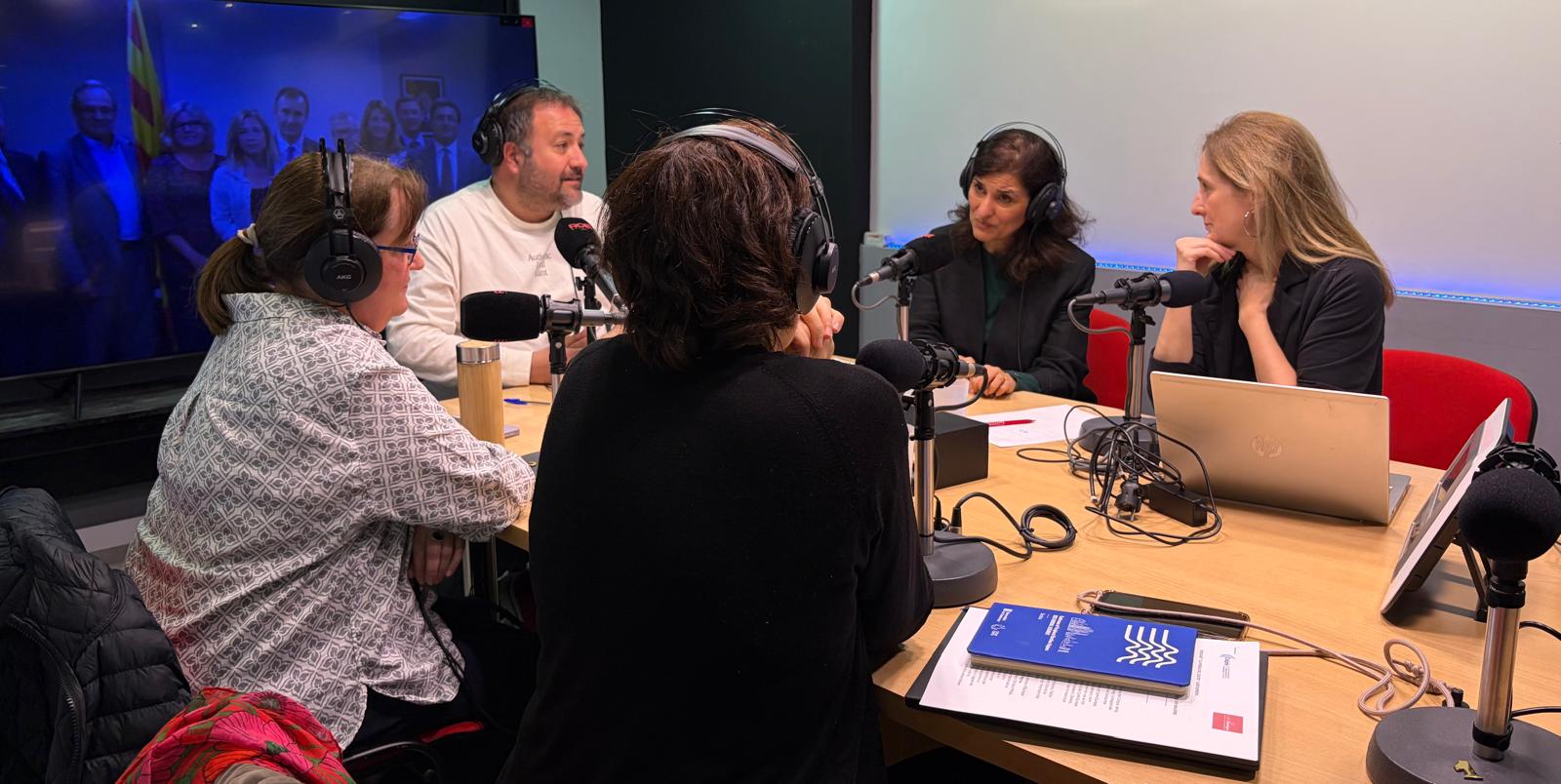
This Friday, March 27, we held a new edition of “Café Europa” to examine one of the most pressing hotspots in current geopolitics: the attack on Iran, the country’s internal situation, and the role of the European Union in the region’s escalating conflict.
Under the title “Europe and the Attack on Iran: Interests vs. Values”, Ryma Sheermohammadi, a sociopolitical analyst specializing in Iran and the Middle East, and Lurdes Vidal, an expert in international relations focused on the MENA region and the Islamic world, discussed the impact of external attacks, the fragility of international law, and the response—or lack thereof—by European institutions.
The session was led by sociologist Aran Solé and moderated by Débora Miralles, head of the International Relations Commission at COLPIS, and Dolors Camats, director of the Fundació Catalunya Europa.
Collective Trauma and the Mirage of Internal Change
The session began by focusing on the country’s internal reality, as Ryma Sheermohammadi reminded participants that Iran had just experienced a bloody January, with repression leaving thousands dead in the streets. According to the analyst, the narrative that an external attack could weaken the regime is false: “Who believes that a population under bombardment, watching people being massacred and their homes destroyed, is going to take to the streets?” She also stressed that the bombings do not help the opposition; instead, they force the population to focus solely on survival.
For her part, Lurdes Vidal pointed out that the regime is undergoing an internal transformation toward greater militarization. Power is shifting from the religious sector to the Revolutionary Guard, making the Islamic Republic “less and less a republic and less and less Islamic.” This shift in the balance of power further complicates any short?term prospects for a democratic transition.
Europe: Stupefaction and Double Standards
A central theme of the debate was the European Union’s apparent inability to maintain a unified and coherent voice. Vidal described Europe’s reaction as a mix of astonishment and inaction in the face of the volatility of the Trump administration’s policies. “Europe’s response reflects a certain inability to react to the outbursts of a U.S. president whose next move is impossible to predict,” she noted.
The discussion also highlighted Europe’s contradictions regarding its values. While the EU considered the 2015 nuclear deal its major diplomatic achievement, the speakers agreed that human rights and support for the Iranian diaspora were neglected. This prioritization of security interests over democratic values has reinforced the perception of Brussels’ “double standards.”
The debate further explored how external actors are instrumentalizing the conflict. The speakers analyzed how Benjamin Netanyahu uses the escalation to consolidate his government and divert attention from the Palestinian issue. China was also identified as the “elephant in the room,” seen as the ultimate target of U.S. strategic ambitions in the region.
The session concluded with a reflection on the emerging world order, in which brute force seems to be replacing international law. The speakers warned that while media attention focuses on missiles over Iran, de facto annexations are taking place in the West Bank and a growing humanitarian crisis is unfolding in Lebanon.
Recover the "Cafè Europa"
In Youtube
In podcast format on Spotify